00 map
01 The Origin of the Name ‘Mukibanda'
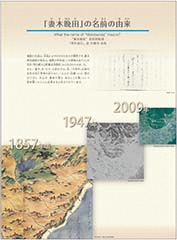
The Mukibanda Yayoi Site name comes from the name of the municipal division where the central part of the site is located (aza Banda, oaza Muki, Daisen-cho, Saihaku District), and from the conventional nicknames of "Mukiyama" and "Bandayama". However, the origin of the name "Muki" is unknown, but the following reports from the Edo period provide some insight.
1)Hoki Mindanki
Folk Tales from Hoki <completed in 1742 by Matsuoka Nobumasa, feudal lord of the Tottori Domain>Emperor Konin's Empress consort was born in this land, and, by command of the emperor, it became known as Tsumaki Village (literally "village that wife came from").
2)Asazuma Engi
Asazuma Engi<author and date of completion unknown (possibly the late Edo period)>Emperor Monmu's Empress consort was born in this land, and it derives from the poem that the Emperor composed:
In Hoki, clouds bridge Daisenji Temple to Tsumaki Village, so I hear.
02 ‘Yama no Seikurabe’ (The Tale of the Mountains Competing for Their Heights)
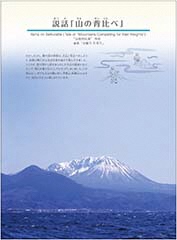
Once upon a time, a deity of Korea carried his prized Mt. Kara all the way across the sea to compare its height with Mt. Daisen. However, astonished by the majestic form of Mt. Daisen that appeared between clouds, he left Mt. Kara and returned home. This mountain still remains at the foot of Mt. Daisen, but is familiar to the locals as Mt. Korei.
03 Let’s Look For the Ruins Around Mukibanda Yayoi!
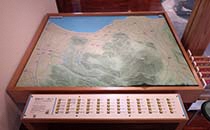 On the western side of the Yodoe Plain, there once was a lake (lagoon) that connected with the sea. The lagoon served as a port and point of exchange with various regions, making the area very populous. As a result, there are numerous archeological ruins dating from the Jomon, Yayoi, Kofun and Asuka periods.
Press the switch on the right to discover the location of these ruins!
04 ‘Kunibiki Shinwa’ (The Myth of ‘Pulling the Lands’)
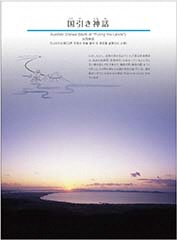 Once upon a time, Yatsukamizu Omitsuno, a deity and ruler of Izumo Province, tied a thick rope to the excess land of Tsutsu Cape in Koshi (Hokuriku region) and pulled it in to create Miho Cape. The rope he used to pull the land at this time became Yomi Island (Yumigahama). The post he moored the land to became Hinokami Mountain (Mt. Daisen).
05 Aerial View of the Mukibanda Yayoi Ruins
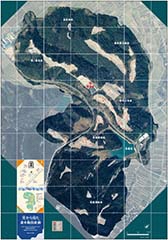 Mukibanda Yayoi Ruins (Designated National Historic Site)
Location: Daisen-cho, Saihaku-gun, Yonago-shi, Tottori Prefecture
A Yayoi Period settlement where the remains of about 1000 buildings and a large amount of ironware have been excavated. The site spans an area of approximately 170 hectares, one of the largest in Japan.
Date of Designation: December 22nd, 1999 (Heisei 11)
06 Change of the Village
1)Formation of the Village
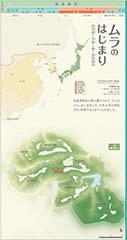
Dwellings were built, and people began to live in Matsuogashira district. In the other districts, storage pits were constructed.
2)Emergence of the Chieftains’ Tombs
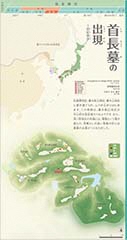
Dwellings were built in Matsuogashira, Muki Niiyama, and Mukiyama districts, and the village began to grow. In that time, it appears that Muki Niiyama district was the central residential area. Also, a moat was dug at the edge of Dounohara district, and the tombs of chieftains were built on a hill with a commanding view.
3)Expansion of the Village
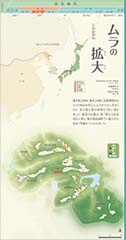
Centered on the three districts of Muki Niiyama, Mukiyama, and Matsuogashira, the village grew even larger, and the number of dwellings increased to double the amount of the previous period. The chieftain's tomb was moved from Dounohara to Sentani district, and Sentani No. 1, the largest tomb in the Mukibanda Yayoi Settlement Site, was built.
4)The Village’s Golden Era
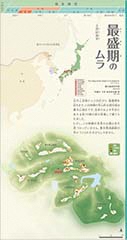
In its heyday, the village spread across the entire hilltop. In this period, Mukiyama was the central residential area. Approximately 70 dwellings, which constituted about half of the total number of dwellings, were built closely together. However, the gravesite for the chieftain of this period has still not been discovered. It may have been created outside of the Mukibanda Yayoi Settlement Site.
5)Decline of the Village
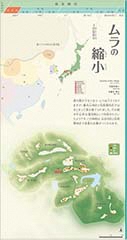
Although the number of dwellings decreased and the village became smaller, many houses were built close together in Mukiyama and Matsuogashira districts. It appears that these districts continued to be used as the central residential areas. In this period, tombs for the chieftains were built in Sentani and Matsuogashira districts.
6)The Demise of the Village and Construction of Kofun (Burial Mounds)
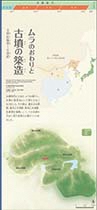
By the Kofun period, the village had shrunk and was no longer used as a residential area. After that, the tombs of the influential people who ruled the area were built: the Mukiyama Tumulus Group, the Bandayama Tumulus Group, the Bandayama Tumulus Group, and the Matsuogashira Tumulus Group.(The two "Bandayama" are separate place names and are written in different kanji.)
07 Building the Storehouse
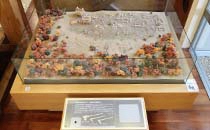 In the hilly terrain on the west side of Dounohara, a moat was dug in the middle of the first century. In the second century, this moat was filled in, and a pit house and raised floor storehouse were constructed. Here, a scene from the building of the raised floor storehouse has been recreated.
The lumber used for the pillars and wall boards is procured from the nearby forest. In the interior, trees are being cut down with stone axes. Afterwards, the branches and bark are stripped from the tree.
To the left, planks for the walls of the raised floor storehouse are being made. There were no saws in the Yayoi period. To make the planks, the tree was split by driving a wedge into the log, and the surface had to be made flat by using a stone or iron hand adze.
Besides lumber, many other materials were necessary. The people in the middle are making a rope to tie lumber together.
Next to them, grass for thatching is being gathered. In this way, one building is completed through the cooperation of many people.
(scale: 1/50)
08 How Did the Yayoi People Use Timber?
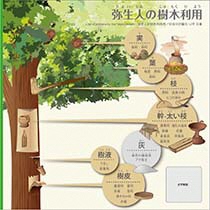
Berries: Food, dyes
Leaves: Compost, fuel, dyes
Branches: Fuel, tool handles, basket making
Trunks & Thick Branches: Building materials, ceremonial tools, containers, weapons, cooking utensils, hunting tools, agricultural tools
Ashes: Mordant for dyeing, removal of astringent taste from food
Sap: Lacquer, glue
Bark: Roofing materials, wall materials, containers, dyes, wrapping material, clothing
Mallet and Spoon (Japanese Camellia) -Using durable materials
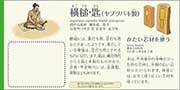
It seems that there were mallets for crushing leaves and mallets for crushing beans amongst others. The mallets on display are similar to the ones used to crush beans. For spoons, there were both earthen and wooden spoons from the Jomon period. From the Nara and Heian periods, there were also metal and seashell spoons.
The wood has a reddish core material and white sapwood exterior. A hard, rot-resistant material is used for the core of the mallet.
The exhibits are full-size recreations of artifacts excavated from the Aoya Kamijichi Site.
Spade (Japanese Evergreen Oak) -Using hard wood
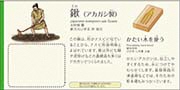
This hoe is called an eggplant shaped hoe because its shape resembles that of an eggplant. In addition to the hoe, many agricultural tools such as plows and mudguards were made from Japanese evergreen oak.
In order to make the hard wood of this tree easier to process, it was softened by soaking in water. Lumber yards for this purpose have been found in sites such as the Nishikawatsu Site in Shimane Prefecture.
The exhibits are full-size recreations of artifacts excavated from the Ikenouchi Site.
Adze (Japanese Cleyera) -Using a branch
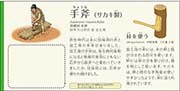
In the Yayoi period, there were axes mainly for felling trees and hand adzes for processing wood. Hand adzes used for processing wood changed from stone to iron adzes with the spread of ironware during the late Yayoi period; however, stone axes continued to be used for felling trees.
To make adzes used in processing, the part of a tree where trunk separates to branch is used. The blade is attached to the trunk, and the branch is used as the handle. The angle that the trunk and branch of Cleyera japonica (sakaki) form made the resulting adze easy to use, and thus was frequently used.
The exhibits are full-size recreations of artifacts excavated from the Aoya Kamijichi Site.
Pedestal Dish (Chinese Mulberry) -Cutting timber in a way to minimize warping
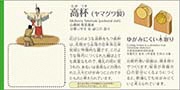
Pedestal bowls with decorations that resemble petals are distinctive vessels of the regions along the Japan Sea coast from Hokuriku to San'in. Such elaborately made vessels were extremely valuable and believed to be either something used during rituals or something that only certain people could possess, such as a chieftain.
Comparatively shallow receptacles were made using the yokokidori technique which processes lumber by laying logs on their sides. It is believed that by making the bowl so the straight grain runs around the rim, the shape will not warp, even when dried.
The exhibits are recreations at 70% of the size of artifacts excavated from the Aoya Kamijichi Site.
Bowl (Zelkova) -Using attractive grains
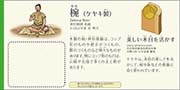
There are various types of wooden bowls such as cup-shaped vessels, bowls with handles, and bowls with legs. In particular, many cup-shaped vessels have been unearthed in the San'in and Hokuriku regions.
Utilizing the beauty of the grain of the tree, Japanese zelkova is frequently used in bowls and other tableware.
The exhibits are full-size recreations of artifacts excavated from the Aoya Kamijichi Site.
Tub (Japanese Cedar) -Cutting timber into a desired shape
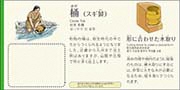
Tubs hollowed out from a single block of wood started to be made around the middle of the Yayoi period. Though some have been unearthed from Kinki to Kyushu, a particularly large number have been unearthed from San'in and Hokuriku.
Making deep tubs and things that are longer than wide such as ladles using the yokogidori technique (processing wood horizontally) would necessitate extremely large trees; therefore, they are made using the tategidori technique (processing lumber vertically).
The exhibits are full-size recreations of artifacts excavated from the Aoya Kamijichi Site.
09 Wood used by Yayoi people
Japanese cedar (Sugi)
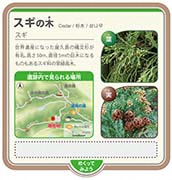
The Jomon Sugi, a large Japanese cedar located in a UNESCO World Heritage Site on Yakushima, is famous. A tall, evergreen tree of the Japanese cedar family that includes some giant trees that reach 50 m in height and 5 m in trunk diameter.
Japanese Zelkova (Keyaki)
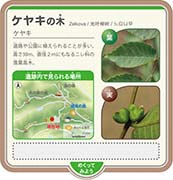
Japanese zelkova are often planted along roads and in parks. A deciduous tree of the Ulmaceae family that can grow to a height of 30 m and trunk diameter of 2 m.
Mulberry (Kuwa)
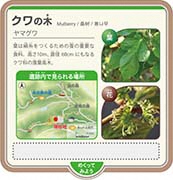
Mulberry leaves are important as the source of food for silkworms. A deciduous tree of the Moraceae family that can grow to a height of 10 m and trunk diameter of 60 cm.
Cleyera japonica (Sakaki)
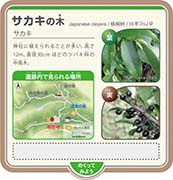
These trees are often planted in shrines. A medium sized tree of the Pentaphylacaceae family with a height of 12 m and trunk diameter of 30 cm
Japanese Camellia
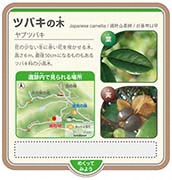
A tree blooming red flowers in winter when flower fields are scarce. A small tree of the Camelliaceae family that can grow to a height of 6 meters and a diameter of 50cm.
Acorn Tree - Japanese Evergreen Oak
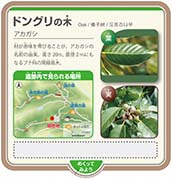
The name Akagashi (‘red oak’) comes from the reddish color of the wood. A tall evergreen tree of the beech family, it can reach a height of 20 meters and a diameter of 2 meters.
Japanese Chestnut (Kuri)
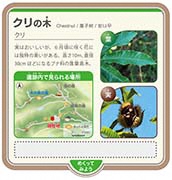
The Japanese chestnut produces delicious nuts and, around June, flowers that have a unique fragrance. A deciduous tree of the Fagaceae family that can grow to a height of 10 m and trunk diameter of 30 cm.
10 The Village’s Four Seasons and Gift of Nature
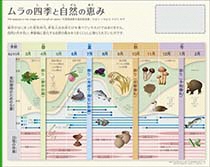
Rice cultivation began in the Yayoi period; however, the Yayoi people did not only eat rice. They faced their environment squarely and skillfully made use of the gifts of nature that changed with each season.
Spring-Summer Version
Various Uses
Shells・Sea Urchin
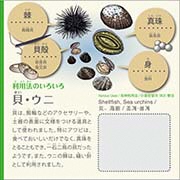
Shells were used as accessories such as bracelets and as tools to imprint patterns on the surface of earthenware. In particular, abalone were not only delicious to eat, but could also hold pearls. Also, the spines of sea urchins were used as sewing needles.
Deer
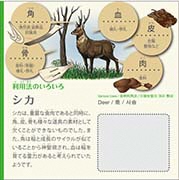
Deer were both an important source of meat and an essential source of the antlers, skin, and bones used as materials to make various tools. Also, they were regarded as a sacred animal because of the similarities in the growth cycle of antlers and rice, and their blood was believed to have the spiritual power to grow rice.
Rice Fields
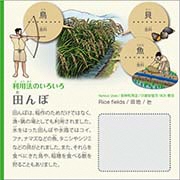
Rice fields were not only used for rice cultivation, but also for fishing and hunting. From the water-filled rice fields and waterways, the Yayoi people caught fish such as carp, crucian carps, and catfish, and also gathered shellfish such as river snails and basket clams. Also, they hunted the birds that came to eat the fish and shellfish and the beasts that came to eat the ears of rice.
Autumn-Winter Version
Various Uses
Pampas Grass
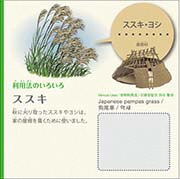
The pampas grass and reeds harvested in the Fall were used to thatch the roofs of homes in the village.
Birds
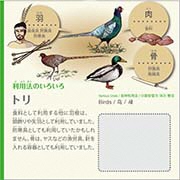
Not just used as a food source, birds’ feathers were also used as headdresses and arrow feathers.
They may also have been used in clothing to keep heat during the cold weather. The bones were made into containers to keep hooks and fork-like fishing tools.
Wild Boar・Tanuki・Rabbits
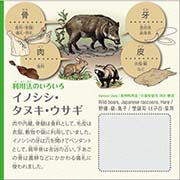
Flesh, organs and bone marrow were eaten as food, while fur and skin were used in clothing, rugs and pouches.
Wild boar tusks were drilled and worn as pendants, the shoulder blades used in fortune-telling, and lower jawbones were used for farming rituals.
Rice Paddies
Rice paddies were used not only for rice cultivation, but also for fishing and hunting.
Fish such as carp, crucian carp, and catfish, as well as shellfish such as pond snails and clams were caught in the flooded rice paddies and canals. They also hunted birds that came to eat the fish and animals that ate the ears of rice.
Shells・Sea Urchin
Shells were used as accessories such as bangles and as tools for making patterns on the surface of pottery. Abalone, in particular, was not only delicious to eat, but it also produced pearls, killing two birds with one stone. The spines of sea urchins were also used as sewing needles.
11 Ironware in Mukibanda Site
The Road of Iron
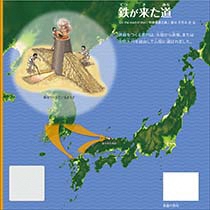
The materials used to make ironware were brought to the Sanin region directly from mainland Asia via northern Kyushu.
Making Iron Tools
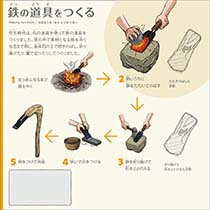
In the Yayoi period, stone tools were used to make iron tools. This was done by heating the raw iron material in a charcoal until glowing red, hammering it on an anvil stone, bending it, and then cutting it with a chisel.
1 Heat iron until it glows bright red
2 Hammer iron while hot
3 Bend iron to adjust shape
4 Sharpen to make a blade
5 Complete by fixing to a handle
Iron Tools That Changed Everyday Life
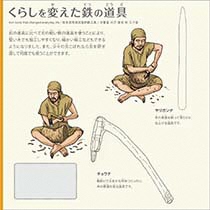
By using iron tools with sharper blades than stone tools, it became easier to work with hard wood, and elaborate workmanship became possible. Also, even if slightly chipped or nicked, iron blades could be re-sharpened and reused over and over again.
12 Buildings at the Mukibanda Site
Roofs of Pit Houses
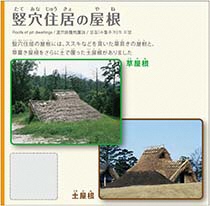
Amongst the pit house roofs, there were both thatched roofs of Japanese pampas grass; and mud roofs made with mud covering a thatched roof.
The Layout of the Villages
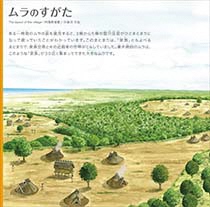
In the restorations from some periods of the village’s history, groups of between 3 to 5 pit houses appear bunched together. These groupings could be considered “families,” with the head of the family and close relatives living together in one “household.” At the Mukibanda site, up to 30 of these small “families” grouped together make up the larger Mukibanda village.
Families and Dwellings
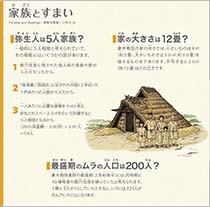
<Did the Yayoi people all live in families of 5?
>
It is generally believed that the typical family would consist of 5 people, the evidence for this theory is as follows:
1) The number of eating utensils found in the pit dwellings indicate that 5 people lived there.
2) In China in the 2nd century A.D, it is said that generally 5 people lived in each dwelling, as was written in the “Records of the 3 Kingdoms.”
3) When considering a typical living space of 3m2 for each person, and taking into account the space for the furnace, it is calculated that about 5 people would live in each dwelling. (20m2/Total floor space – 3m2 for furnace ÷ 3m2 per person = 5.6 people per house.)
<Was the typical floor space 20m2 (12 tatami mats)?
>
The dwellings in the Mukibanda site range in size from 8m2 (5 tatami mats) to 50m2 (30 tatami mats). The average size of the dwellings is around 20m2 (12 tatami mats).
<Did the Village population exceed 200 at its peak?>
The latter half of the second century A.D. was the most prosperous age for the Mukibanda Village. At that time it is believed that there were up to 45 pit dwellings. If there were 5 people living in each dwelling that amounts to a population of 225 village inhabitants.
13 Restoring Buildings from the Yayoi Period
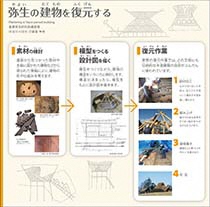 Examining the Building Materials
By combining the information offered from the remains of the building materials, and looking at images of buildings etched into recovered earthenware, we can ascertain the shape and structure of the buildings.
Building Models and drawing Design Plans
Through model building, we can closely examine the structure of the buildings. Once the structure is set, the model is used as a reference when drawing up the building design plans.
Restoration Work
In every part and process of the restoration work, a full range of traditional woodworking and architectural techniques is used to rebuild the dwellings.
1) Material Processing
Timber felled from the mountains is processed using a hand adze to produce a beautiful, smooth wood surface.
2) Assembly
Timber pieces with natural bends are painstakingly selected to fit the intended shape of the building structure.
3) Thatched Roofing
The rooftops are layered with thatching made of Japanese Pampas grass and reeds.
4) The Completed Restoration
14 Model of the restored building
A Burnt Pit House
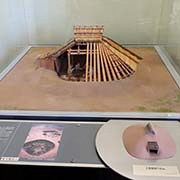
No. 43 Pit House found in Mukiyama district is a pit house with a mud roof that burnt down from a fire. A dwelling from the most prosperous time for Mukiyama district, about 1,800 years ago during the latter half of the late Yayoi period, the corners are shaped like rounded rectangles, and each side is about 5 meters large.
The pillars, rafters, thatched roof, and mud piled on top remained in almost exactly the same condition after burning down; therefore, it was possible to recreate the construction of the dwelling's roof. The roof consisted of a base of closely arranged plank rafters; the next layer was bundles of thatching grass thickly packed in a horizontal direction; on top of that, a second layer of thatch laid in a longitudinal direction that was covered with mud.
The Chieftain’s Residence
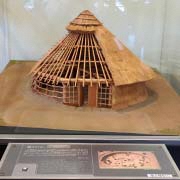
This building is a recreation of the large No. 45 Pit House that was built 40 m to the northeast of the one-story building with eaves. There is no central pillar inside this dwelling. Instead, 7 small pillars positioned along the walls support the roof. Inside, fragments of a bronze mirror brought from China were unearthed. These mirror pieces had been reused as a pendant. From the artifacts and its construction, it is believed that this was the dwelling of the chieftain who ruled the village.
The Village Shrine
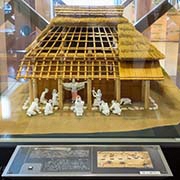
This building is a recreation of the large No. 41 Hottatebashira (literally "embedded pillars") Building found in Matsuogashira district. The one-story building has five pillars on the long side and four on the short side, eaves on both sides of the main building, and a hip roof where all sides slope downwards to meet the walls. The main building is about 36 m2. The latticed windows of the model were recreated by referencing the ones unearthed at the Aoya Kamijichi Site. Close to this building, there is a large pit house thought to belong to the village's ruler. This building with eaves is thought to have been used as a shrine where the village's festivals were held.
15 Evidence of exchange between communities
The Yayoi Network – Trade at Mukibanda
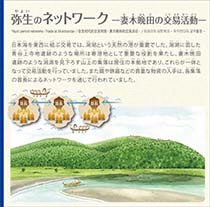
In a trade that connected the east and west regions along the Sea of Japan, lagoons were important as natural ports. Locations facing lagoons, such as the Aoya Kamijichi Site, played an important role as ports of call. Mountain villages overlooking lagoons, such as the Mukibanda Yayoi Settlement Site, were the residential bases. Together, they formed a network for trade activities. Also, in order to obtain valuable items such as mirrors and ironware, trade was conducted through a network of village chieftains.
Broken Mirror Excavated from the Mukibanda Ruins
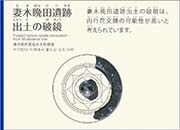
This broken mirror excavated from the Mukibanda site is believed to be a mirror with an inner flower design.
Distribution of Ironware Along the Japan Sea
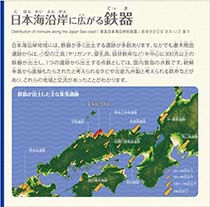
Along the Sea of Japan coastal areas, there are many archaeological sites where lots of ironware has been unearthed. In terms of the number of pieces unearthed at one site, the Mukibanda Yayoi Site ranks amongst the highest in the nation. Small tools such as spear shaped planes, punches, and socketed adzes made from iron form the majority of the more than 300 pieces that have been excavated here.There are spades believed to have been brought directly from the Korean Peninsula as well as iron axes believed to have been made in northern Kyushu which indicates exchange with those areas occurred.
Forged Narrow Spade excavated from the Mukibanda site.
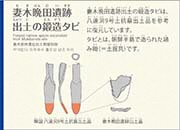
This forged narrow spade was recreated using pieces recovered from the 9th excavation site in the Hattatsu Cave. This style of spade was first made on the Korean Peninsula and was used as a foot plow or a digging tool.
Casting Trapezoidal Spade excavated from the Mukibanda site.
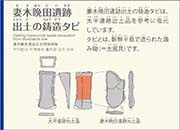
This trapezoidal spade was recreated using pieces recovered from Mukibanda, and through referencing examples found at the Oonaru excavation site. This style of spade was first made on the Korean Peninsula and was used as a foot plow or a digging tool.
Socketed Iron Adze with Folded Band, Made in Northern Kyushu Area
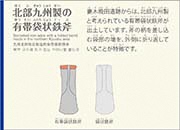
A socketed iron adze with a folded band excavated from the Mukibanda Ruins, thought to have been made in the northern Kyushu area. The edges of the bag, where the handle of the adze is inserted, are folded outward.
Iron Smithing at the Mukibanda Ruins
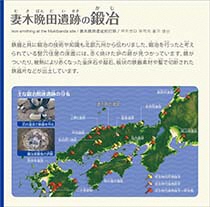
Along with ironware, the knowledge and techniques of blacksmithing were also transmitted from northern Kyushu. Red burn marks from a furnace where discovered on the floor surface of a pit house where blacksmithing is thought to have occurred. Anvil stones and hammer stones that have rusted and turned red due to heat, sheets of raw material for ironware, and ironware scraps severed with a chisel have been unearthed.
Making of Iron Implements and Iron Scraps
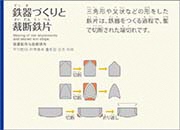
Iron fragments in triangle or fork-like shapes are scraps cut by chisels in the ironware making process.
Exchange of Stone Implements
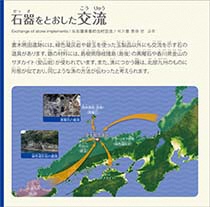
In the Mukibanda Yayoi Site, in addition to the jewels made from jade, green tuff and jasper, there are stone tools that indicate exchange with other areas. Obsidian from the Oki Islands in Shimane Prefecture and sanukite (andesite) from Kanayama in Kagawa Prefecture were used as materials for arrowheads. Also, the weights used in fishing are similar in shape to those of northern Kyushu, and it is believed that a similar fishing method was transmitted.
Beads and Bead-Making at the Mukibanda Ruins
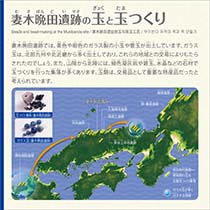
Blue and navy blue beads and tubular beads made from glass have been unearthed at the Mukibanda Yayoi Site. These were probably brought by trade with northern Kyushu and northern Kinki where large amounts of glass has been unearthed. Also, from San'in to Hokuriku, there were many villages that engaged in bead-making using stones such as green tuff, jasper, and crystal. It is believed that jade, as a trade item, was an important special product.
How to Make Green Tuff Beads
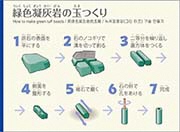
- Flatten the surface of the raw ore.
- Cut a groove into the stone with a small saw.
- Bisect repeatedly to make a rectangle.
- Smoothen the sides.
- Polish with whetstone.
- Make a small hole with an iron needle.
- Complete.
How to Make Jasper Beads
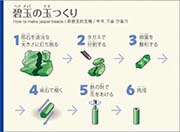
- Break the raw ore into appropriately sized pieces.
- Divide using a chisel.
- Smoothen the sides.
- Polish with whetstone.
- Make a small hole with an iron needle.
- Complete.
Exchange of Pottery
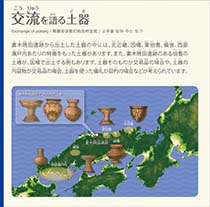
Among the earthenware excavated from the Mukibanda Yayoi Site, there are pieces with the characteristics of north Kinki, Inaba, east Hoki, Bingo, and the western Setouchi areas. There have also been cases where earthenware from Hoki, which is within the Mukibanda Yayoi Site, has been unearthed in Inaba. It is possible that the earthenware itself was the trade good, or the content of the earthenware was the trade good, or even that the purpose was a ritual that used the earthenware.
Exchange of Ritual Practices
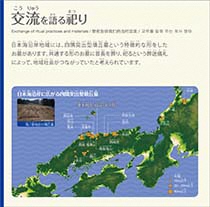
In the regions along the coast of the Sea of Japan, there are gravesites that have a distinctive square mound with four protruding corners shape. It is believed that regional communities were connected by the funeral ritual of burying and enshrining chieftains in gravesites of a common shape.
Interaction with the Continent – Riding Ocean Currents
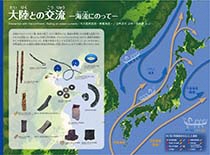
Mirrors, iron axes and swords, and glassware brought from the continent were precious items that symbolized authority.
Amongst these items, there are items such as mirrors that were brought by way of northern Kyushu; however, there are also items such as spades and broadaxes made on the Korean Peninsula that have not been unearthed in northern Kyushu despite the large amounts of ironware found there. This indicates the existence of a fleet that sailed the Tsushima Current to directly visit the Sea of Japan coastal areas for trade.
Villages Linked with Lagoons
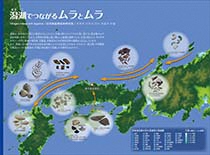
A lagoon is a shallow lake separated from a larger body of water by the formation of a sandbar or other barrier in the mouth of a bay. Sheltered from harsh ocean waves, mooring in lagoons was easy. This made them the ideal location for ports that served to link the east and west regions along the Sea of Japan. As a sign of this exchange, ironware, fishing equipment, jewels made from jade, and wooden products with the same workmanship and design have been unearthed from ruins along the coast of the Sea of Japan.
Also, by traveling upstream rivers that flow into lagoons, exchange is possible with villages inland. Sanukite (rock similar in composition and appearance to andesite) and earthenware ritual implements are typical examples of items distributed across the Chugoku Mountains.